How to Land a Ski Jump

Bianca
| 04-11-2026
 · Sport Team
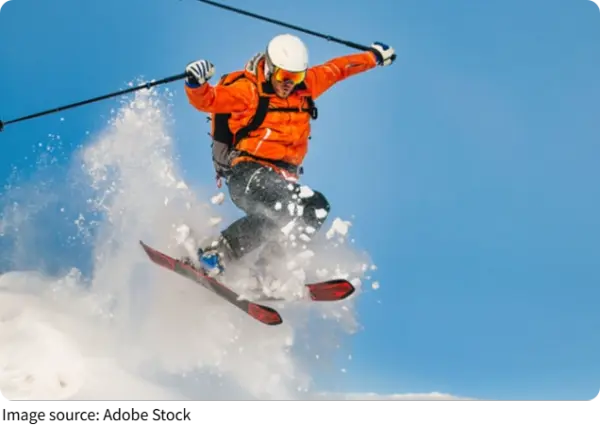
You watch a skier launch off a kicker, a small take-off ramp, and float through the air. From the bottom of the hill, the landing looks effortless.
It isn't. The touchdown is where most jumps get lost, not in the air. Get the landing right and the whole jump feels controlled. Get it wrong and you're on your back in the powder. Stance, knee flex, speed, landing angle and gaze each play a part, and all of them can be practiced.
Start With the Right Stance
Landing prep begins before you leave the lip, the edge of the take-off. Come into the jump with your hands forward and your weight slightly over the balls of your feet, not sitting back on your heels. That forward position keeps you from getting pitched backward when the ground comes up.
If your hands drift behind your hips, your chest opens and you lose control of the touchdown. Keep them out front where you can see them.
Absorb, Do Not Fight It
The ground hits harder than you expect. Your knees and hips need to flex on contact to soak up the force, the same way you'd cushion a drop off a small cliff. Bend deep, then rise back to a neutral stance.
Skiers who land stiff-legged get bounced forward or thrown off balance. Think of your legs as springs that compress and release. In a terrain park, that flex can be a good six to eight inches of travel at the knees.
Match the Slope, Not the Air
Many jumpers keep the angle they had in flight and land nose-first into the hill. Instead, aim to touch down with your skis parallel to the landing slope. Look at where you're going to land as you approach the lip, not straight ahead.
On a well-built jump the sweet spot sits just past the knoll, the rounded part at the top of the landing, where the slope angles down steeply enough to soften the impact. Landing short on the flat before the knoll is where landings hit hardest.
Set Your Speed Before the Lip
Hitting that sweet spot depends largely on your speed at the take-off. Too slow and you drop short onto the knoll; too fast and you can fly past the landing slope onto the flat runout below. Watch a few riders go first, note where they start their approach, and pick a similar spot.
Speed is easy to add a little at a time on later runs. Once you are in the air, there is nothing left to adjust.
Keep Your Eyes Down the Hill
Your head leads the rest of you. If you stare at your ski tips on touchdown, your shoulders drop and you fold forward. Keep your gaze out toward the runout, roughly 20 feet ahead, and your body follows.
This one habit fixes a lot of wobbly landings. It also sets you up to ski away instead of stopping dead on the landing.
Practice the Small Stuff First
Don't learn landing technique on the biggest jump in the park. Start on small kickers where a mistake means a stumble, not a fall, and repeat until the flex and the forward hands feel automatic.
A coach or an experienced friend watching from the side can tell you instantly if you're sitting back. Film a few attempts on your phone, too. The video shows the lean you can't feel in the moment.
Next time you stand at the top of a kicker, run a quick check before you push off: speed set, hands forward, knees ready to flex, and eyes on the landing past the knoll. Watch your clip afterward and work on whichever one slipped.