Hidden Signals

Nolan O'Connor
| 20-04-2026
 · Animal Team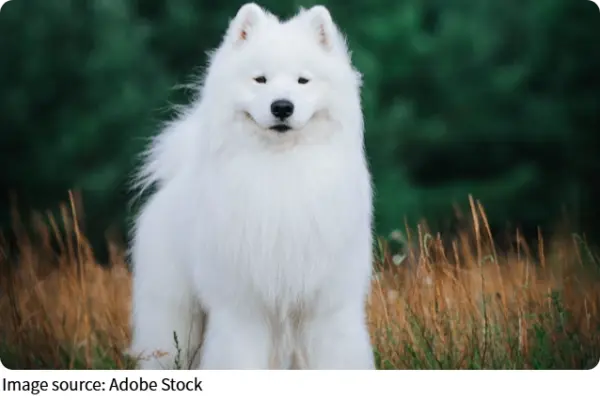
When we see a Samoyed, the first thing that catches our attention is its bright “smile.” It often looks like it is always happy, gentle, and full of warmth. Many of us feel instantly comforted by that expression. But is that smile really only about happiness?
In reality, the story is more interesting. A Samoyed’s “smile” is not just an emotional signal. It is also closely related to its body design and natural needs. Today, we will explore the truth behind this famous expression so we can better understand what our fluffy friend is really feeling.
The “Smile” Is Not Always Emotion
We often assume that a Samoyed is happy whenever it looks like it is smiling. However, this is not always correct. A Samoyed can appear to smile even when it is simply breathing heavily, feeling warm, or slightly nervous.
For example, after running or playing, we may see it opening its mouth with a lifted mouth shape. In hot weather, the same expression becomes even more obvious. At first glance, it looks joyful, but in reality, the dog might just be trying to cool down or adjust to its surroundings.
To truly understand its mood, we must look at more than just the mouth. The tail, ears, and overall posture give us much clearer clues.
Reason One: Natural Head Design Creates a Smiling Look
One major reason for the “smile” comes from the Samoyed’s natural head design. Its head shape and the way its mouth is positioned naturally create an upward curve at the corners.
The mouth is wider and shaped in a smooth curve, which makes the corners gently lift even when the dog is relaxed. The surrounding muscles also stay loose in a resting state, which enhances this lifted look.
Because of this, even when the dog is calm, resting, or simply observing its environment, it may still appear to be smiling. This is why many people call it a “born smiling face.” Even young puppies show this soft expression early in life.
So, part of the smile is not a message. It is simply how the face is naturally built.
Reason Two: Cooling the Body Creates a Smile Effect
Another important reason is temperature control. Samoyeds were originally adapted to cold regions and have a thick double-layer coat. This makes it harder for them to release heat quickly.
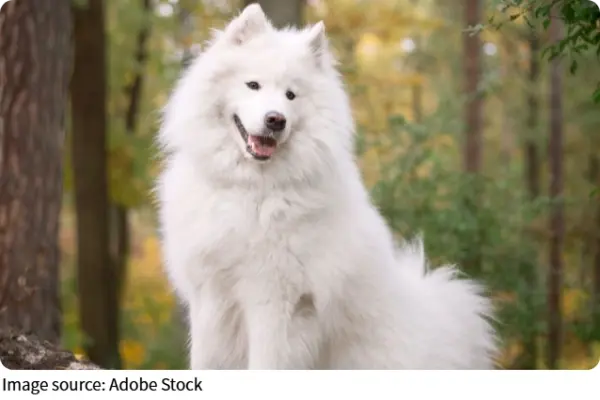
To cool down, they rely mainly on fast breathing. When they open their mouth and breathe rapidly, air flows through the tongue and mouth area, helping reduce body warmth.
During this process, the mouth naturally lifts, and the tongue may hang slightly. From the front view, this looks like a big happy smile.
We often notice this after outdoor play or during warm days. The expression becomes more obvious, but it is actually a cooling response, not always emotional joy.
How We Can Tell True Happiness?
To understand when a Samoyed is truly happy, we need to observe its whole body language, not only its mouth.
A genuinely happy Samoyed usually shows a relaxed tail that moves in a smooth and natural rhythm. Its ears stay soft, slightly forward or resting comfortably. The body looks loose, and it may come closer to us gently or lean in for contact.
Sometimes it may lie down near us or follow us around with light, springy steps. These combined signals show real comfort and trust.
When we see all these signs together with the “smile,” we can be more confident that the dog is truly feeling good.
Warning Signs Hidden Behind a Smile
Not every smile means happiness. In some situations, the expression can hide stress or caution.
A nervous Samoyed may look like it is smiling, but its body becomes stiff. The tail may stay low, and the ears may press back. The eyes may stay wide and alert, scanning the surroundings.
There is also a defensive expression where the mouth opens more widely and more teeth are visible. In this case, the body is tense and the dog may growl softly. This is a clear warning signal.
When we notice these signs, it is important to give space and avoid sudden movement. Calm behavior helps the dog feel safe again.
Understanding the Real Story Behind the Smile
A Samoyed’s smile is a mix of natural design, body function, and emotion. Sometimes it reflects happiness. Sometimes it helps with cooling. Sometimes it is simply how the face is shaped.
When we learn to read the full picture, we begin to understand our fluffy companion more deeply. We stop guessing and start observing. That is how real communication builds between us.
So Lykkers, the next time we see that famous “smile,” let’s also look at the ears, tail, and posture. Behind that charming expression, there may be a completely different story waiting to be discovered.
What about your Samoyed? When do you think its smile looks the happiest?